2048
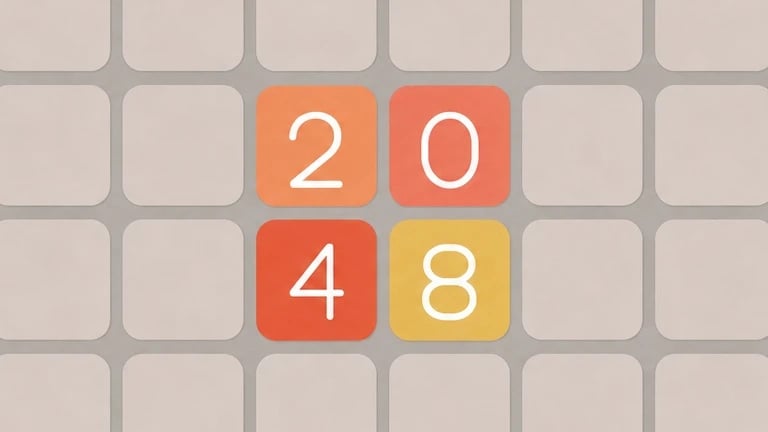
2048 is a free, open-source puzzle game created in 2014 by a 19-year-old Italian web developer named Gabriele Cirulli, who built it over a single weekend and published it on GitHub under the MIT License. It went on to consume roughly four million human lives in its first week. Not because it's complicated — it's the opposite of complicated — but because your brain will not let you stop. Here's the deal. You've got a 4×4 grid. Two tiles are sitting on it, each showing the number 2. You swipe in a direction — up, down, left, right — and every tile on the board slides that way until it hits a wall or another tile. If two tiles with the same number collide, they merge into one tile worth their sum. Two 2s become a 4. Two 4s become an 8. Two 8s become a 16. After every swipe, a new tile (usually a 2, occasionally a 4) pops up in a random empty space. Your goal is to keep combining tiles until you forge the mythical 2048 tile. The problem is that every move spawns a new tile, the grid is only 16 squares, and the moment you can't move — because every space is full and no neighbors match — you're dead. It's basically a territory war between you and entropy, and entropy is very patient. The strategy is deceptively deep for something with four inputs. Experienced players will tell you to pick a corner, keep your biggest tile parked there, and build a descending cascade along one edge — sort of like organizing a shelf where the heaviest books go on one end. The moment you let a big tile drift into the middle, your board starts to choke. You'll develop opinions about this. You'll start swiping left in your sleep. This is normal. It's free, it's open-source, it runs in any browser, and a round takes about ten minutes — or four hours, depending on how many times you whisper "one more try" to yourself. You should play it right now. You should also clear your afternoon.
- Developer
- gabriele cirulli
- Released
- March 9, 2014
- Last updated
- March 29, 2026
- Languages
- English