2014

Hextris is a fast-paced puzzle game where colored blocks fall from the edges of the screen toward a central hexagon, and you rotate that hexagon to catch them on its six faces. When three or more blocks of the same color touch each other on adjacent faces or stacked on the same face, they disappear and everything above slides down. Let any stack grow past the outer grey hexagon boundary and it's over. The core mechanic is deceptively simple: blocks fall, you rotate left or right, colors match and clear. But the speed ramps quickly, and the six-sided geometry means you're managing six independent stacks simultaneously while blocks rain in from every direction. You have to think about where each color is building up, which face has room, and whether rotating to catch an incoming block will accidentally bury a color you were about to clear somewhere else. It's the Tetris problem of "I need this piece but not here" multiplied across six faces at once. Combos are where the scoring gets interesting. Clear multiple color groups in quick succession and a combo timer appears as a receding outline around the outer hexagon. Chain clears within that window and your score multiplies. High-level play is about setting up chain reactions, intentionally letting colors stack in ways that cascade into multi-clear combos when you finally trigger them. Created by a group of high school students from Boston at a hackathon and refined over three months, Hextris hit #1 on Hacker News, trended on GitHub, and became one of those games people pass around in browser tabs at work. It's built entirely in JavaScript on the HTML5 Canvas, runs in any browser, and is fully open source under the GPL license. No ads, no monetization, no installs. The flat UI design is clean and readable even at high speed, which matters when you're spinning a hexagon and tracking four incoming blocks at once. FEATURES ∙ Rotate a hexagon to catch falling colored blocks on six faces ∙ Match 3+ same-colored blocks to clear them ∙ Chain clears for combo multipliers ∙ Escalating speed keeps every session intense ∙ Clean flat UI designed for readability at high speed ∙ Runs in any browser, no install required
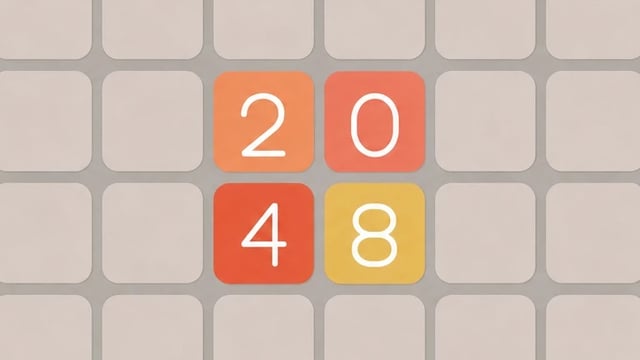
2048 is a free, open-source puzzle game created in 2014 by a 19-year-old Italian web developer named Gabriele Cirulli, who built it over a single weekend and published it on GitHub under the MIT License. It went on to consume roughly four million human lives in its first week. Not because it's complicated — it's the opposite of complicated — but because your brain will not let you stop. Here's the deal. You've got a 4×4 grid. Two tiles are sitting on it, each showing the number 2. You swipe in a direction — up, down, left, right — and every tile on the board slides that way until it hits a wall or another tile. If two tiles with the same number collide, they merge into one tile worth their sum. Two 2s become a 4. Two 4s become an 8. Two 8s become a 16. After every swipe, a new tile (usually a 2, occasionally a 4) pops up in a random empty space. Your goal is to keep combining tiles until you forge the mythical 2048 tile. The problem is that every move spawns a new tile, the grid is only 16 squares, and the moment you can't move — because every space is full and no neighbors match — you're dead. It's basically a territory war between you and entropy, and entropy is very patient. The strategy is deceptively deep for something with four inputs. Experienced players will tell you to pick a corner, keep your biggest tile parked there, and build a descending cascade along one edge — sort of like organizing a shelf where the heaviest books go on one end. The moment you let a big tile drift into the middle, your board starts to choke. You'll develop opinions about this. You'll start swiping left in your sleep. This is normal. It's free, it's open-source, it runs in any browser, and a round takes about ten minutes — or four hours, depending on how many times you whisper "one more try" to yourself. You should play it right now. You should also clear your afternoon.
Puzzle · Relaxing · Minimalist